-

Kate Flournoy replied to the topic An argument: charm is found in the unexplored in the forum Annual Theme Discussion 7 years, 10 months ago
I have arrived.
@Eden-anderson wellll… the one @daeus-lamb is talking about isn’t published yet and probably won’t be for a while. 😛 He threw me for a bit of a loop with singling me out here, because I really haven’t the slightest clue about how to do that intentionally. My secret’s out. I’m just an accidental genius.
But as I have been tagged and I can’t let my reputation suffer (horrors), I’ll try to explain what I think probably goes into creating that kind of timeless wonder.
Try— I’ve been trying to come up with a coherent answer for a week and I’m still not sure I’ve got it straight. XD
First off, I completely agree with everything that’s been said here so far. @corissa @noahlitle you people have great thoughts. I’m probably just going to end up rephrasing the same concepts. 😉
I actually feel like there are two answers to this question and they work in tandem. The technical answer, and the theoretical answer.
I’m going to do theoretical first because I’m mean like that.
Daeus, your second post about the subconscious hit the nail on the head.
As soon as I saw this topic, I remembered something from my childhood that I’d buried pretty far back in my memory. Any of you ever read Wind in the Willows? The unabridged version? If you haven’t, the basic premise is it’s about a mole (yes, an actual mole) who lives with his friend the River Rat on the banks of a river and has all kinds of adventures with his other two friends, Mr. Badger and Mr. Toad. It sounds childish, but it really was a masterpiece of children’s literature and I still enjoy glancing through it from time to time.
There was one chapter I remember more vividly than all the rest. The Piper at the Gates of Dawn. Mole and Ratty went out on the river in the middle of the night to search for a lost baby otter and ended up wandering far beyond their usual haunts. They stayed out all night, and just as dawn was beginning to break, they heard the music of a reed pipe from somewhere up ahead. They followed it, both so tired they were only half awake, and came upon a still side-channel full of reeds where they found Him.
He was only ever referred to as Him but described as a great creature with kindly eyes and noble, backswept horns, who played on His pipes to bring the dawn. Sleeping peacefully at His feet was the baby otter they’d gone out to find. They took the otter into their boat, and when they looked again He was gone, so they rowed back to the river and went home, and never spoke of it, not even to each other.
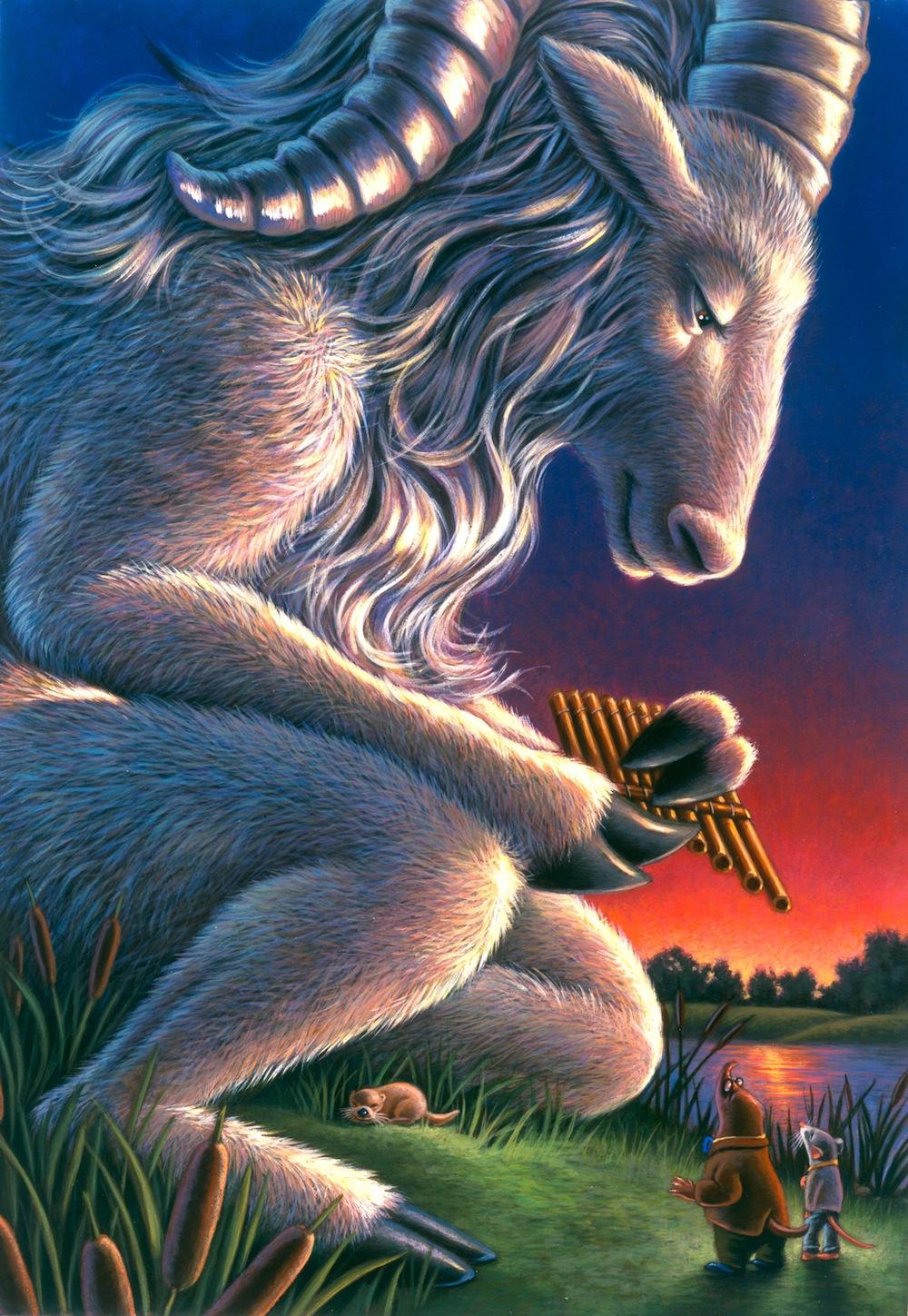
Just remembering it makes me cold all over. It was the only moment like it in that book, but that single memory makes the whole book come back to me as a masterpiece.
That scene, for all intents and purposes, was a dream sequence, yet the characters were not asleep. How did it achieve the mystery and wonder of a dream without truly being a dream itself?
Dreams in stories are used for three things: to foreshadow, to set mood, and to touch strings in the story that are otherwise mostly hidden. Dreams are to a story what fantasy is to real life: a slightly fantastical exaggeration of circumstances that frees us from the plain and ordinary reality of things and permits us to examine hidden and relevant truths in a clearer light.
This hidden story is important because it’s the only story. There are mechanical ways to manufacture a sense of wonder (much like a good soundtrack can patch up a not-so-amazing movie) but the wonder that lasts is wonder that resonates deeper than the reader has thought to look on their own. Deeper than just emotion, though emotion is important.
This is where the theoretical stuff is. A timeless story, in my experience, is one that empowers the reader to discover deep and wonderful and terrible things about himself. Beyond just relating to a character, or a situation, or a certain event, he should recognize the timeless story of humanity in the work, and understand it in ways that terrify, intrigue, and mystify him. Humanity is portrayed with depth and understanding that makes him pause in the middle of a sentence, stare at the page, and think ‘Oh yeah… I’m a human. This— this— is talking about me.’
Writers, it’s on us to ask for the wisdom to do this. Living will give it to us—the longer we live, the wiser we get—but God can help too. He wrote a whole book on it. 😉
On top of that, I’ve noticed that when I take advantage of my own emotions and sense of wonder and permit myself to ‘gush’ (even if I have to go back and tighten it up later) my wonder always bleeds out onto the page. There was one scene towards the end of my story that I’d been looking forward to for literal years. Several times I was tempted to skip ahead and just write it, then fill in the space between, but I didn’t. By the time I got there, I was so euphoric and delighted that it had FINALLY arrived I wrote the whole thing in one sitting and loved the result (rare, believe me. 😛 ). It’s the only scene in that story I feel is perfect just the way it is.
So in addition to working with your reader’s sense of wonder, you also have to work with yours. No wonder in the writer, no wonder in the reader.
The nice thing is, humans are made to look for these things. Ever wonder why Noah’s descendants at the Tower of Babel had to make their own gods when they turned their back on the One true God? Because man knows, inherently, that he is born to worship something. Born to look up. Born to understand and question. He’s born knowing that the world is more than just what meets the eye and grows up seeking it everywhere. He can no more deny that in himself than he could grow gills and learn to breathe underwater. Even atheism is a religion of ‘wisdom’ and ‘understanding’ (enlightenment, they would call it). Man isn’t content to eat, sleep, work, repeat. Even the least ambitious, most stolid of us has a philosophy that we’ve gleaned from processing the world around us and forming opinions about life and why it matters and what it should be used for. We recognize wonderful things and are irresistibly drawn towards them.
So now we move into the slightly more technical stuff, though we’re not all the way there yet. (Daeus, I’m going to sue you if my fingers drop off in the middle of this post.)
There are two factors to awakening a sense of wonder, and fittingly enough, neither of them belong to the writer. Remember always that this is about the reader—the impressions you can make on him; how you can serve him. Your job is to recognize these two factors of your reader’s psychology and to understand how they work together.
The two factors are emotion and soul. The soul is what seeks to understand and gain wisdom and what drives a man to worship. But emotions are important too. You might say they’re a doorway to the soul. One of the reasons music can be such a worshipful experience for so many of us is that it awakens emotions that soften our hard hearts and allow our souls to be touched.
But notice that while music can drive us to worship, it is not the music itself that we worship. So it isn’t enough to just have emotional stories—the emotions have to serve some higher purpose and point towards a bigger picture. We might have the most emotional story in the world—amazing relationships between characters, gripping conflict, deep love, intense hatred, burning jealousy, etc., but if there is no context of deeper understanding, and the emotion is simply there for emotion’s sake, it’s a huge let-down.
What happens when you evoke emotions is that you open the doors of the soul and prepare it to receive something wonderful. If you leave that promise unfulfilled, you cheated—yourself and the reader.
But how do we reveal this wondrous ‘deeper story’ in a storyworld that’s distinctly physical and commonplace?
Very sparingly. Too much wonder loses its sparkle, at least in the case of more dramatic moments and deeper revelations. Choose your moments carefully and place them with art and strategy.
One of my favorite ways to explicitly incorporate deeper truths that are necessary to the story’s theme (without falling into the ‘preachy’ trap) is to use a single line at the end of a very intense emotional scene. Say the hero and his sister are arguing because the hero wants to do something rash and his sister knows he’s doing it is because he’s desperately insecure and craves attention. We could have her spout off all these logical and theological reasons why he’s doing wrong, but that doesn’t give us much emotion, does it? Instead, we could spend the whole scene having them get angrier and angrier and arguing in true illogical sibling fashion, damaging their relationship until the reader is pounding his head against the wall and begging them to stop, and then the sister yanks the door open and storms out with this parting shot: ‘Well I guess it’s too bad the world doesn’t revolve around you!’
Emotion first. Soul/depth/truth/whatever afterward. If you do this consistently your reader will start getting excited every time they sense emotion coming, because they instinctively know it’ll end up somewhere deeper. They start connecting threads before they even get there and all their faculties are on high alert, devouring every smaller truth, symbol, and example of the larger truths your story was written to explore.
Now we come to the truly technical stuff. Maybe you’d better go get a drink of water or eat a cookie or a raspberry or something.
So… *clears throat and nervously clasps hands* I have been planning to write a book on what I’m about to tell you for a while. It’s a sort of pet theory I have and I can’t quite decide what it is. I wanna call it chemical, but I also wanna call it neurological, but I also wanna call it psychological…
I call it the Dichotomy Rule. It’s my attempt to explain the psychology of reader engagement. If I could write it as a formula, it would probably look something like this: 1+1=3
*remembers the time she tried to explain this to a friend using the Trinity as an example**decides not to try that again*
In its simplest form, it looks like this:
She smiled happily
Vs
She smiled sadly.
The first one is weak. There is one impression repeated twice: smile, and happy. 1+1, in this case, only =1. Not only did we not achieve something intriguing, we didn’t even achieve something beneficial. We only repeated ourselves and annoyed the reader. Meh. No magic.
The last one is stronger because it contradicts itself. There are two impressions: smile, and sad. 1+1. When you put them together, their contradiction creates something entirely different. It’s defined by neither of the two impressions, but by the impossible relationship between them. 1+1=3.
Magic.
Dichotomy.
This applies to every single aspect of storytelling. You know that one character duo whose chemistry you adore because they couldn’t be more opposite and shouldn’t really get along, but when they do they astound the world? Thank the Dichotomy Rule. If they didn’t clash in so many aspects of their personality and worldview, where would the magic of their relationship be? Of course nice people are going to love nice people. Bad people are going to relate to bad people. Motivated people are going to stick with other motivated people. Birds of a feather flock together.
Blah. Boring. Give me the hero in love with the villain. Give me the villain who worships the hero’s innocent child and would die for him. Give me the motivated king who loves his lazy sister.
Give me dichotomy. Give me something impossible, so I can wonder at it and be amazed. It gives me intellectual meat to chew on with my mind, emotional meat to delight my heart, and spiritual meat that encourages me and gives me strength.
Charm is found in the unexplored and the inexplicable.
And I am done. I think. There’s so much more that could be said about this, but if I don’t stop I’ll never be finished. XD
*flops down in a chair**eats raspberries*
Thoughts?
Article Categories